
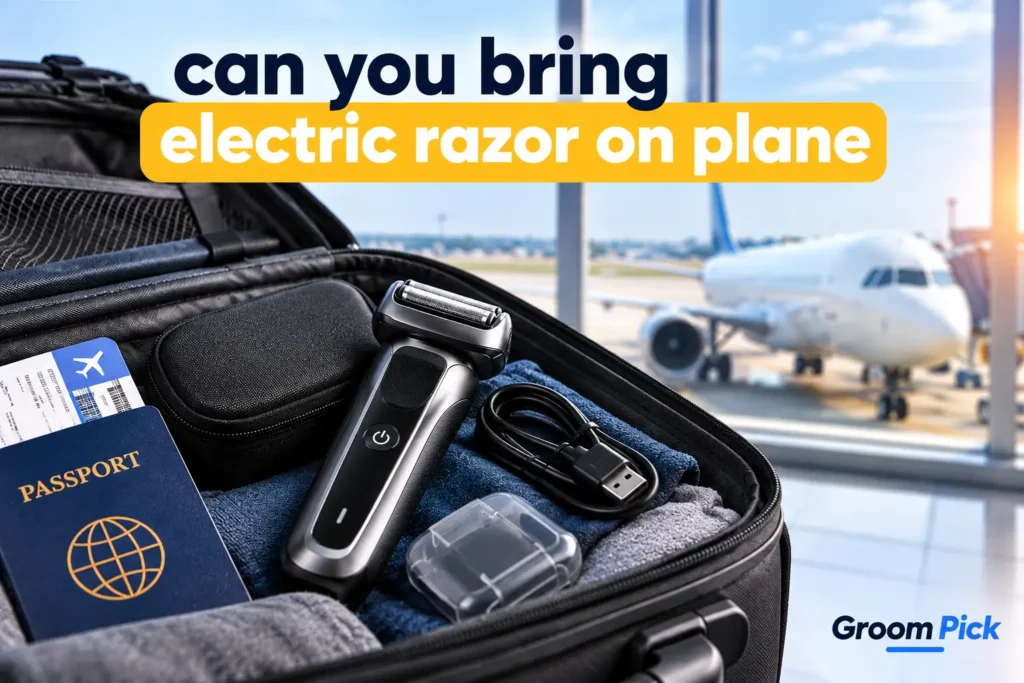
can you bring electric razor on plane? Yes. Most travelers can take an electric razor on a flight, and carrying it in your hand luggage is usually the simplest option.
The main thing to check is the razor’s battery. Rechargeable electric razors often use lithium-ion batteries, so battery safety rules apply. The FAA and IATA recommend keeping many lithium-powered electronic devices in the cabin when possible.
Table of Contents
Electric Razor on a Plane: Key Facts
An electric razor is generally permitted on a plane, but where you pack it can depend on the battery inside the device.
| Travel question | General guidance |
|---|---|
| Electric razor in carry-on | Generally allowed |
| Electric razor in checked luggage | May be allowed if properly switched off and protected |
| Spare lithium battery | Carry in hand luggage |
| Damaged battery | Do not take it on the aircraft |
| Charging cable | Generally allowed |
| International travel | Check each airline’s rules |
| Best packing option | Carry-on luggage |
Airline rules can be stricter than general aviation rules, so check the carrier operating your flight before departure.
Electric Razor Carry-On Rules
An electric razor carry-on is usually the easiest way to travel because the device stays accessible throughout your trip.
If your razor has a lithium-ion battery, keeping it in the cabin also follows the general safety approach recommended by aviation authorities. The FAA says lithium-powered portable electronic devices should be carried in carry-on baggage when possible.
Before placing the razor in your bag:
- Turn it completely off.
- Activate the travel lock if it has one.
- Put the protective cap over the shaving head.
- Place it inside a case or pouch.
- Keep the charging cable nearby.
- Make sure the battery is not damaged or swollen.
A protected razor is less likely to turn on accidentally or become damaged during travel.
Electric Razor Checked Luggage Rules
An electric razor may be allowed in checked luggage, but the rules depend on its battery and the airline.
Under FAA guidance, a portable electronic device containing a lithium battery placed in checked baggage must be completely powered off and protected against accidental activation and damage. It should not be left in sleep or standby mode.
For this reason, your electric razor checked luggage option is usually less convenient than carrying it with you.
IATA’s 2026 passenger guidance also distinguishes between installed batteries and spare batteries. Devices with batteries up to 100 Wh can generally be carried in cabin baggage, while spare batteries cannot be placed in checked baggage.
Electric Shaver on Airplane: What About Lithium Batteries?
An electric shaver on airplane travel is usually straightforward when the battery is small and properly packed.
Most personal electric shavers use relatively small rechargeable batteries. IATA specifically lists electric shavers among everyday devices that may contain lithium batteries.
For rechargeable lithium-ion batteries, the general threshold is 100 watt-hours. Batteries between 100 and 160 Wh can require airline approval, while batteries over 160 Wh generally fall outside normal passenger baggage allowances.
A typical personal electric razor is normally far below these limits. Still, checking the manufacturer’s battery information is useful if you have an unusual or high-powered device.
For a broader explanation of battery packing, see the IATA guide to safe travel with lithium batteries. It covers carry-on rules, spare batteries, watt-hour limits, and what to do if a bag is gate-checked.
Can You Take an Electric Shaver on a Plane Internationally?
Yes, but international trips require extra care because different airlines and national authorities can apply different requirements.
If you have connecting flights, check the rules for each airline. The rules for your first flight may not be identical to those for a later connection.
IATA states that baggage requirements can vary by airline, route, and local regulations. Airlines may also impose restrictions that are stricter than general guidance.
For international travel, keep these points in mind:
- Pack the razor in your carry-on when practical.
- Keep the device switched off when packed.
- Protect the shaving head.
- Carry spare lithium batteries in the cabin.
- Check the airline’s current battery policy.
- Follow security instructions at your departure airport.
Electric Razor Airport Security Rules
Electric razor airport security rules are generally straightforward, but screening procedures can vary between airports.
An ordinary electric razor is not the same as loose razor blades or other sharp cutting tools. Security officers may still ask you to remove electronics from your bag or present an item separately during screening.
Keep your razor accessible rather than burying it under clothes and toiletries. That makes the screening process easier if an officer wants to inspect it.
Also remember that airline baggage rules and airport security rules are separate. An item may pass security screening but still be subject to an airline’s baggage restrictions.
Beard Trimmer on a Plane: Does It Follow the Same Rules?
Yes. A beard trimmer on a plane generally follows the same basic battery principles as an electric razor.
Cordless beard trimmers commonly use rechargeable lithium-ion batteries. If yours does, pack it securely and preferably keep it in your carry-on bag.
The same approach applies to:
- Beard trimmers
- Hair clippers
- Rotary shavers
- Foil shavers
- Rechargeable grooming kits
If a trimmer has a removable spare battery, treat the spare battery separately. Spare lithium batteries must remain in carry-on baggage and should be protected against short circuits.
Rechargeable Razor on a Plane: How to Pack It
A rechargeable razor on a plane is easy to pack if you prepare it before reaching the airport.
Use this simple checklist:
- Turn the razor completely off.
- Activate the travel lock.
- Check the battery for damage.
- Protect the shaving head.
- Place the razor in a pouch or case.
- Put it in your carry-on bag.
- Keep spare batteries in their protective packaging.
- Do not put loose spare lithium batteries in checked luggage.
If your carry-on is taken at the gate and placed in the aircraft hold, remove lithium-powered devices and spare batteries when required and keep them with you in the cabin. FAA and IATA guidance specifically highlights this gate-check situation.
Can You Use an Electric Razor During a Flight?
Being allowed to carry an electric razor does not automatically mean you can use it during the flight.
Airlines can set rules about when and how electronic devices may be used. Cabin crew instructions always take priority.
There is also a practical issue. Electric razors can create noise and loose hair, which may disturb other passengers.
If you want to shave while traveling, it is usually easier to use the razor before leaving for the airport or after reaching your destination.
Common Electric Razor Travel Mistakes
Most problems can be avoided with a few simple checks before leaving home.
Packing a Spare Battery in Checked Luggage
Spare lithium batteries must not be placed in checked baggage under standard FAA guidance. Keep them protected and accessible in your carry-on.
Leaving the Razor in Standby Mode
A device in sleep or standby mode is not the same as being completely switched off. If the razor goes into checked luggage, switch it off completely.
Traveling With a Damaged Battery
Do not pack a razor with a swollen, damaged, defective, or recalled lithium battery. The FAA says damaged or recalled batteries that could create dangerous heat or sparks must not be carried unless they have been made safe.
Assuming Every Airline Has the Same Rules
Airlines can apply additional restrictions. Always check the rules for your actual carrier, particularly when traveling internationally.
Electric Razor Plane Travel Checklist
Use this checklist before leaving for the airport:
- Razor is completely switched off.
- Travel lock is activated.
- Battery shows no signs of damage.
- Protective cap is fitted.
- Razor is packed in a case or pouch.
- Razor is in your carry-on when practical.
- Spare batteries are in your carry-on.
- Spare battery terminals are protected.
- Airline battery rules have been checked.
- Gate-check instructions are understood.
These steps cover the most common battery and baggage concerns without making packing complicated.
Can You Bring Electric Razor on Plane? Bottom Line
Yes, you can generally bring an electric razor on a plane. For most travelers, putting the razor in a carry-on bag is the simplest approach.
If the razor contains a lithium battery, keep it protected and switched off. Spare batteries belong in your carry-on, not your checked luggage. If a device must go in checked baggage, it should be completely powered off and protected from accidental activation and damage.
Frequently Asked Questions
Can you bring an electric razor on a plane?
Yes. You can generally bring an electric razor on a plane. Carrying it in your carry-on bag is usually the simplest option, especially when it contains a lithium-ion battery.
Can you bring an electric razor in carry-on luggage?
Yes. Electric razors are generally allowed in carry-on luggage. Keep the razor switched off and protected from accidental activation during your journey.
Can you put an electric razor in checked luggage?
An electric razor may be permitted in checked luggage when it is completely switched off and protected from accidental activation or damage. Airline rules may vary.
Can you bring a rechargeable razor on a plane?
Yes. Rechargeable razors can generally be taken on planes. If the razor uses a lithium battery, follow the applicable battery packing rules and keep spare batteries in your carry-on.
Can you bring a beard trimmer on a plane?
Yes. A cordless beard trimmer can generally be carried on a plane. If it contains a lithium battery, pack it securely and preferably keep it in your cabin baggage.
Can you use an electric razor during a flight?
It depends on the airline and crew instructions. Being allowed to carry an electric razor does not automatically mean you can use it during the flight. Follow all cabin crew instructions.