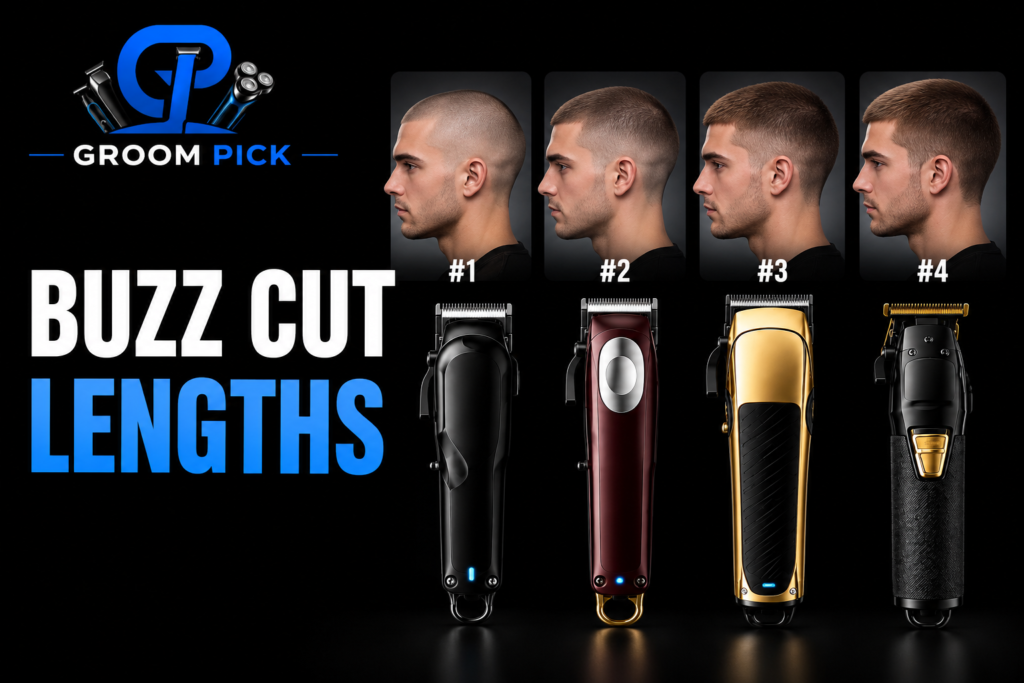
Choosing the right buzz cut lengths is easier when you understand clipper guard numbers. A #1, #2, #3, and #4 can all look very different, even though the numbers are close.
The main rule is simple: the higher the guard number, the more hair it leaves behind. Standard clipper guards range from extremely short cuts to around 25 mm, giving you plenty of options.
Whether you want a sharp military-inspired cut, a classic buzz, or a slightly longer style, the right length depends on your hair type, head shape, and how much scalp coverage you want.
Table of Contents
Buzz Cut Lengths at a Glance
This table gives you a quick way to compare common clipper numbers and their approximate lengths.
Measurements can vary slightly between clipper brands, so check your clipper before cutting.
| Guard | Approx. Length | Appearance |
|---|---|---|
| #0 / No Guard | Very short | Nearly shaved |
| #1 | 3 mm | Very short |
| #1.5 | 4.5 mm | Short with more coverage |
| #2 | 6 mm | Classic buzz |
| #3 | 10 mm | Fuller buzz |
| #4 | 13 mm | Longer buzz |
| #5 | 16 mm | Long buzz |
| #6 | 19 mm | Very long buzz |
| #7 | 22 mm | Long clipper cut |
| #8 | 25 mm | About 1 inch |
Wahl’s official guide lists #1 at 1/8 inch, #2 at 1/4 inch, #3 at 3/8 inch, and #4 at 1/2 inch.
Buzz Cut Lengths Men Should Know
For buzz cut lengths men commonly request, #1 through #4 are the most useful options.
Each length creates a different balance between scalp visibility, coverage, and maintenance.
#1 Buzz Cut
A #1 leaves roughly 3 mm of hair. It creates a very short, clean appearance with noticeable scalp visibility.
This length works well if you want:
- A bold, minimalist haircut
- Almost no styling
- A sporty appearance
- Very easy washing and drying
- A sharp, close-cropped look
The downside is that a #1 reveals more of your scalp and natural head shape. Uneven areas can also become more noticeable.
#2 Buzz Cut
A #2 leaves around 6 mm of hair and is one of the easiest buzz cuts to wear.
It is short enough to look clearly buzzed but provides more coverage than a #1. For many people, this is the best starting point.
A #2 works especially well if you want a low-maintenance haircut without going extremely short.
#3 Buzz Cut
The #3 leaves around 10 mm of hair. It has a fuller appearance and gives you more texture than a #1 or #2.
This is a strong choice if you want a buzz cut that feels less severe. It can also work well for thick hair because there is enough length for the hair’s natural texture to remain visible.
#4 Buzz Cut
A #4 leaves about 13 mm, or half an inch, of hair.
At this length, the haircut looks fuller and softer. It still has the clean nature of a buzz cut, but it does not expose as much scalp.
Wahl notes that #4 territory can begin moving toward crew-cut or brush-cut styles, especially when the sides are tapered.
4 Buzz Cut: Is It Better for More Coverage?
A 4 buzz cut is a good option if you want short hair without an extremely close appearance.
At approximately 13 mm, it gives you noticeably more coverage than a #1 or #2.
It can be especially useful if you are trying a buzz cut for the first time and feel unsure about going very short.
A #4 also gives you more flexibility when combining lengths. For example, you could keep the top at #4 and gradually shorten the sides with #3, #2, and #1 guards.
That creates a subtle fade while keeping the overall haircut short.
Buzz Cut Lengths Female Styles
Buzz cut lengths female styles use the same clipper measurements as men’s cuts. The difference is usually the overall design rather than the guard itself.
A #1 can create a very bold and close-cropped look. A #2 or #3 gives more coverage while remaining clearly buzzed.
A #4 or longer can create a softer appearance and leave more visible texture.
Some women also combine a buzzed section with longer hair on top, around the sides, or at the back. This creates styles such as an undercut or disconnected buzz.
The best choice comes down to personal style, hair density, face shape, and how much maintenance you want.
Buzz Cut Lengths Reddit Discussions Often Compare
People searching buzz cut lengths reddit often compare #1, #2, and #3 cuts because small changes in length can produce a very different result.
One useful lesson from these discussions is that the same guard does not look identical on everyone.
Hair thickness, color, texture, scalp tone, and head shape all affect the final appearance. A #2 on thick dark hair may look much fuller than a #2 on fine, light hair.
Photos can therefore help you understand the general look, but the clipper number and millimeter measurement give you a better idea of the actual length.
Buzz Cut Lengths MM: Understanding the Numbers
Buzz cut lengths mm measurements are useful when you want to communicate precisely with a barber or compare different clippers.
The common measurements are approximately 3 mm for #1, 6 mm for #2, 10 mm for #3, and 13 mm for #4.
Here is the simple conversion:
- #1 = 3 mm
- #1.5 = 4.5 mm
- #2 = 6 mm
- #3 = 10 mm
- #4 = 13 mm
- #5 = 16 mm
- #6 = 19 mm
- #7 = 22 mm
- #8 = 25 mm
These measurements are approximate standards rather than a universal rule for every clipper. If you own a different brand, check its guide comb specifications before cutting.
For more practical hair and scalp care advice, see the American Academy of Dermatology’s hair and scalp care guide.
Buzz Cut Lengths With Pictures: What to Check
Searching for buzz cut lengths with pictures can help you choose a style, but do not judge a haircut from the picture alone.
Lighting, hair thickness, camera angle, and scalp visibility can make the same length appear different.
When comparing pictures, look for:
- The actual clipper guard used.
- The hair’s thickness and texture.
- Whether the cut is the same length all over.
- Whether the sides have been faded.
- How much scalp is visible.
- The shape of the head and hairline.
A picture labeled “#2 buzz cut” is useful only if the stated guard number is accurate. If you are showing a picture to your barber, also tell them the length you want in millimeters.
Buzz Cut Lengths Straight Hair
Buzz cut lengths straight hair styles tend to look clean and uniform because straight strands usually lie close to the scalp.
The shorter the guard, the more noticeable the hairline, scalp, and shape of the head can become.
For straight hair, consider:
- #1: Extremely short and sharp
- #2: Classic and balanced
- #3: Fuller with more texture
- #4: Soft and noticeably fuller
Straight hair can also make uneven areas easier to spot. If you are cutting your own hair, use slow, overlapping passes rather than trying to finish quickly.
How to Choose the Right Buzz Cut Length
Choosing the right length comes down to four simple factors.
Think about the amount of coverage you want before picking a guard.
1. Decide how short you want it
If you want the scalp to be highly visible, consider #1 or shorter.
If you want a more traditional buzz, #2 is a good starting point.
If you want additional coverage, choose #3 or #4.
2. Consider your hair thickness
Thick hair generally looks fuller at the same length.
Fine or thinning hair may reveal more scalp, particularly with very short guards.
3. Think about your head shape
A very short buzz exposes more of the natural shape of your head.
If you are concerned about this, starting with #3 or #4 gives you more coverage.
4. Start longer if you are unsure
This is the safest rule for a DIY buzz cut.
Start with #4. If it looks too long, move to #3. You can then go to #2 if you still want it shorter.
You can always remove more hair. You cannot immediately add it back.
Buzz Cut Maintenance Tips
A buzz cut is simple to maintain, but regular trimming keeps it looking sharp.
Shorter cuts often show regrowth faster, so your preferred maintenance schedule depends on how neat you want the style to look.
Keep these habits in mind:
- Clean your clipper after use.
- Keep the blades properly maintained.
- Check around the ears and neckline.
- Use good lighting when trimming.
- Look at the back of your head with a second mirror.
- Trim when new growth starts changing the shape.
Short hair also leaves more scalp exposed to the sun. The American Academy of Dermatology recommends protecting exposed scalp skin with measures such as shade, a hat, or broad-spectrum SPF 30+ sunscreen when appropriate.
Common Buzz Cut Mistakes
The biggest mistake is choosing a length simply because it looks good in someone else’s photo.
Your hair density, texture, and head shape can change the result significantly.
Avoid these common problems:
- Going too short on your first attempt
- Assuming every brand’s guards have identical measurements
- Cutting wet hair when your clipper is designed for dry hair
- Forgetting the back of the head
- Rushing through uneven sections
- Ignoring the neckline and around-ear areas
- Choosing a very short guard without considering scalp visibility
If you are unsure, ask a barber for a #2 or #3 first. These lengths give you a useful middle ground.
Buzz Cut Lengths Pros and Cons
Each length has a different balance between appearance, coverage, and maintenance.
Use this comparison if you are deciding between several guards.
| Length | Pros | Cons |
|---|---|---|
| #1 | Very low maintenance, bold | Shows scalp and head shape |
| #2 | Classic, clean, easy | Still quite short |
| #3 | Fuller, softer, more coverage | Slightly more upkeep |
| #4 | Fuller and relaxed | Less of an ultra-short look |
| #5+ | More texture and styling | Requires more maintenance |
Choosing the Right Buzz Cut Length
The best buzz cut lengths are the ones that match your preferred level of coverage, hair type, and lifestyle.
For most first-time cuts, #2 or #3 offers a practical balance between a clean appearance and enough hair to soften the look.
If you want an extremely short style, choose #1. If you want more coverage, move toward #4 or longer.
Remember that guard numbers are only a starting point. Your barber can combine several lengths to create a fade, taper, or more structured haircut.
The Best Buzz Cut Length Depends on You
The best buzz cut lengths are not always the shortest ones. A #1 creates a bold, close appearance, while a #2 gives you the classic buzz-cut look. A #3 adds coverage and texture, and a #4 creates a fuller, softer finish.
If you are unsure, start with #3 and adjust from there. Once you know how your hair responds to the length, choosing your ideal buzz cut becomes much easier.
Frequently Asked Questions About Buzz Cut Lengths
What is the shortest buzz cut length?
A no-guard or very close clipper cut is among the shortest options. A common #1/2 guard is approximately 1.5 mm, while a #1 is around 3 mm.
Is a #2 buzz cut good for a first haircut?
Yes. A #2 is short enough to create the classic buzz-cut appearance while providing more coverage than a #1. It is a practical starting length for many people.
Can a #3 buzz cut look professional?
Yes. A #3 is approximately 10 mm and can look neat and professional when the neckline, sideburns, and edges are kept clean.
Should I choose a #2 or #3 buzz cut?
Choose #2 if you want a shorter and sharper look. Choose #3 if you prefer more coverage and a softer appearance. When unsure, #3 gives you more room to go shorter later.
Why does my buzz cut look different from pictures?
Hair thickness, texture, color, scalp visibility, head shape, lighting, and camera angles can all change how a particular clipper length looks.
When should I choose a #4 buzz cut?
Choose #4 when you want a short, low-maintenance haircut with more coverage. At about 13 mm, it looks fuller and softer than shorter #1, #2, and #3 cuts.