Choosing the right hair clipper guard sizes makes a big difference in the final haircut. A #1, #2, or #4 guard can create very different results, even when the numbers look close.
If you cut your own hair or simply want to explain a haircut to your barber, knowing what each guard means can save you from an unwanted cut. The key is simple: a higher guard number usually leaves more hair behind.
Table of Contents
Hair Clipper Guards: What Do They Mean?
Hair Clipper Guards are attachments that sit over the clipper blade and control cutting length.
They keep the blade at a set distance from the scalp, helping create a more even cut.
A clipper guard works like a spacer between the blade and your hair. Without a guard, the blade cuts much closer to the skin. With a guard attached, more hair remains.
Common guard sizes include:
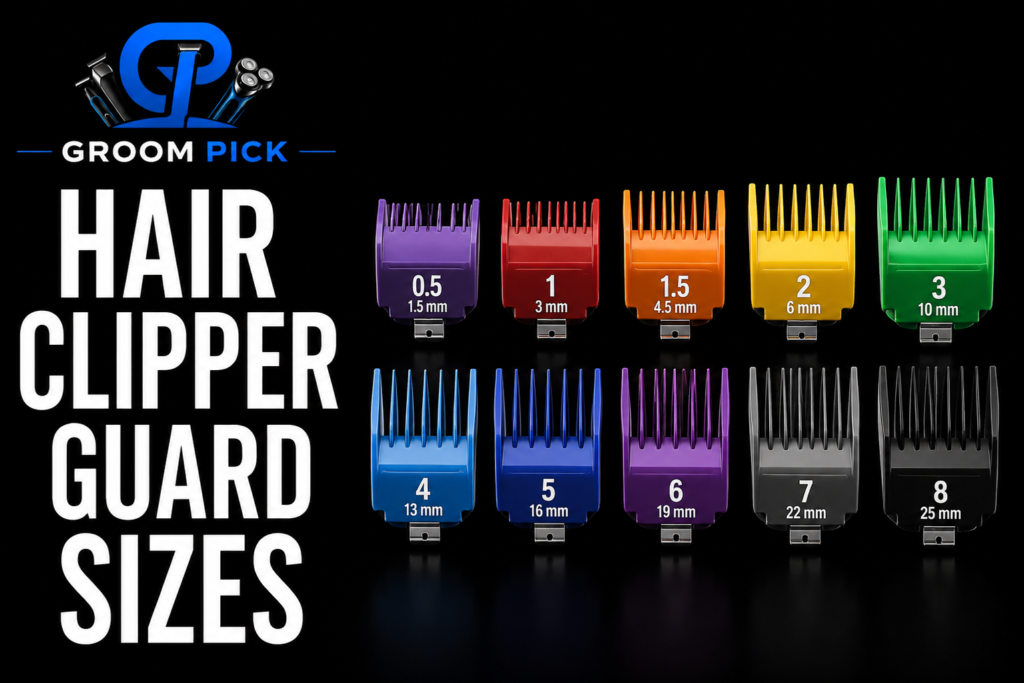
- #0.5: about 1.5 mm
- #1: about 3 mm
- #1.5: about 4.5 mm
- #2: about 6 mm
- #3: about 10 mm
- #4: about 13 mm
- #5: about 16 mm
- #6: about 19 mm
- #7: about 22 mm
- #8: about 25 mm
These measurements are common rather than universal. Guard sizes can vary by manufacturer and clipper model.
Hair Clipper Sizes in mm: Complete Length Chart
Hair clipper sizes in mm show the approximate amount of hair left after cutting.
Millimeter measurements are especially useful when comparing guards from different brands.
| Guard | Length in mm | Approx. inches | Common use |
|---|---|---|---|
| #0.5 | 1.5 mm | 1/16 in | Fades and blending |
| #1 | 3 mm | 1/8 in | Very short cuts |
| #1.5 | 4.5 mm | 3/16 in | Blending |
| #2 | 6 mm | 1/4 in | Buzz cuts |
| #3 | 10 mm | 3/8 in | Short all-over cuts |
| #4 | 13 mm | 1/2 in | Longer buzz cuts |
| #5 | 16 mm | 5/8 in | Medium-short cuts |
| #6 | 19 mm | 3/4 in | Longer clipper cuts |
| #7 | 22 mm | 7/8 in | Keeping more length |
| #8 | 25 mm | 1 in | Long clipper cuts |
For example, a #1 guard is commonly 3 mm, while a #4 is commonly 13 mm. That difference is enough to create a clearly different hairstyle.
Manufacturer documentation should always be checked when exact measurements matter. Wahl’s professional guide, for example, lists common attachment lengths from 3 mm through 25 mm and also states that attachment guard sizes can vary.
Wahl Clipper Guard Sizes in mm: What to Know
Wahl clipper guard sizes in mm are widely used as a reference for standard clipper lengths.
Many common Wahl guide combs follow the familiar 3 mm, 6 mm, 10 mm, and 13 mm sequence.
A typical set may include:
- #1 = 3 mm
- #2 = 6 mm
- #3 = 10 mm
- #4 = 13 mm
- #5 = 16 mm
- #6 = 19 mm
- #7 = 22 mm
- #8 = 25 mm
Wahl also sells clipper systems with different attachment combinations, so you should check the specific model before assuming that every guard set is identical.
This matters when replacing a lost guard or buying an extra set. The number printed on the attachment is helpful, but the actual millimeter measurement gives you a better comparison.
Hair Clipper Guard Sizes in Inches: Simple Conversion
Hair clipper guard sizes in inches are another common way to describe cutting length.
The inch measurement can make it easier to picture how much hair will remain.
| Guard | Approx. mm | Approx. inches |
|---|---|---|
| #0.5 | 1.5 mm | 1/16 inch |
| #1 | 3 mm | 1/8 inch |
| #1.5 | 4.5 mm | 3/16 inch |
| #2 | 6 mm | 1/4 inch |
| #3 | 10 mm | 3/8 inch |
| #4 | 13 mm | 1/2 inch |
| #5 | 16 mm | 5/8 inch |
| #6 | 19 mm | 3/4 inch |
| #7 | 22 mm | 7/8 inch |
| #8 | 25 mm | 1 inch |
You do not need to memorize every conversion.
The easiest reference points are:
#1 = 1/8 inch
#2 = 1/4 inch
#3 = 3/8 inch
#4 = 1/2 inch
#8 = 1 inch
Clipper Guard Sizes With Pictures: How to Visualize Them
Clipper guard sizes with pictures are useful because numbers alone do not show how a haircut will look.
A visual comparison makes the difference between short and longer guards much easier to understand.
Imagine the guards lined up from shortest to longest.
#0.5 Guard
A #0.5 guard leaves about 1.5 mm of hair on systems that use this measurement.
It is very short and is often used when creating a fade. It can also help blend the area between a very close blade setting and a #1 guard.
#1 Guard
A #1 guard leaves around 3 mm.
It creates a very short appearance and can work well for short sides, buzz cuts, and fade work.
Because the hair is so short, the scalp may be more visible depending on hair density, color, and texture.
#1.5 Guard
A #1.5 guard usually leaves around 4.5 mm.
It is particularly useful for blending because it sits between a #1 and #2.
#2 Guard
A #2 guard leaves around 6 mm.
It is one of the most useful choices for a short buzz cut or short sides when you want more coverage than a #1 provides.
#3 Guard
A #3 guard leaves around 10 mm.
It gives a softer, fuller appearance than a #1 or #2 and can work well for an all-over short haircut.
#4 Guard
A #4 guard leaves around 13 mm.
At this length, the hair has more visible texture and coverage. It is useful for a longer buzz cut or for keeping more length on the sides.
#5 to #8 Guards
The larger guards keep progressively more hair.
A #5 leaves about 16 mm, #6 about 19 mm, #7 about 22 mm, and #8 about 25 mm in common systems.
These guards are useful when you want a clipper cut without taking the hair extremely short.
Hair Clipper Guard Sizes Chart for Common Haircuts
A guard chart becomes more useful when you connect each size to a hairstyle.
The best size depends on how short you want the cut and how much coverage you want to keep.
| Haircut | Common guard range | Result |
|---|---|---|
| Very short fade | #0.5–#1 | Tight and close |
| Short fade | #1–#3 | Short with gradual blending |
| Buzz cut | #1–#4 | Uniform short length |
| Longer buzz cut | #3–#5 | More coverage |
| Taper | #0.5–#3 | Short edges with transition |
| Short sides | #1–#4 | Clean and controlled |
| Longer clipper cut | #4–#8 | More visible hair length |
These are starting points rather than fixed rules.
Your barber may use different guards depending on the haircut, hair texture, head shape, and desired finish.
Hair Clipper Guard Sizes in Inches for Buzz Cuts
Buzz cuts are one of the easiest styles to understand using guard measurements.
The same guard can be used all over the head for a simple, uniform result.
A few common choices are:
- #1, 1/8 inch: Very short buzz cut
- #2, 1/4 inch: Short but slightly fuller
- #3, 3/8 inch: More coverage and texture
- #4, 1/2 inch: Longer, softer buzz cut
If you are cutting your own hair for the first time, start with a longer guard.
For example, if you are choosing between #2 and #3, try the #3 first. If it looks too long, you can move down to the #2.
svg: A Simple Visual for Guard Lengths
A visual guard chart can make short clipper measurements easier to compare.
For a published article, use a clean graphic that shows each guard beside its millimeter measurement.
A useful visual could show:
#1 → 3 mm → 1/8 inch
#2 → 6 mm → 1/4 inch
#3 → 10 mm → 3/8 inch
#4 → 13 mm → 1/2 inch
#5 → 16 mm → 5/8 inch
#6 → 19 mm → 3/4 inch
#7 → 22 mm → 7/8 inch
#8 → 25 mm → 1 inch
This type of graphic is also easier to scan than a paragraph of measurements.
1 Clipper Guard in mm: How Short Is It?
A #1 clipper guard in mm is usually about 3 mm.
That equals approximately 1/8 inch in many standard clipper systems.
A #1 is short enough for a clean, low-maintenance look but still leaves a thin layer of visible hair.
It can be used for:
- Short buzz cuts
- Fade transitions
- Short sides
- Tapers
- Blending
If you have a darker scalp or naturally fine hair, a #1 can look particularly close because more of the scalp may show through.
Best Hair Clipper Guard Sizes for Different Styles
The best hair clipper guard sizes depend on the hairstyle you want and how much length you want to keep.
There is no single guard that works best for every haircut.
For a Buzz Cut
Try #1 through #4.
The #2 is a popular middle ground because it is short without being extremely close.
For a Fade
A fade usually needs several lengths.
A barber may move from a very short blade setting to a #0.5, #1, #1.5, #2, and then longer guards.
The purpose is to create a gradual transition rather than a visible line.
For a Taper
A taper focuses on areas such as the sideburns and neckline.
Shorter guards are used around the edges, while longer guards help connect the short sections to the rest of the hair.
For Longer Sides
Use a #4 or larger if you want to preserve more hair.
A larger guard gives you more room to work with and reduces the risk of cutting the sides too short.
How to Choose Hair Clipper Guard Sizes Safely
Choosing a guard is easier when you work from long to short.
This gives you control and helps prevent a haircut from becoming shorter than planned.
Follow these steps:
- Decide your target length. Think about how much hair you want to keep.
- Check the guard measurement. Look for the millimeter marking if available.
- Start with a longer guard. You can always remove more hair later.
- Test a small area. This shows you how the guard behaves with your hair.
- Check the result in good lighting. Uneven sections are easier to spot.
- Move down one size if necessary. Avoid jumping several sizes at once.
- Blend different lengths carefully. Use intermediate guards for smoother transitions.
Wahl’s own haircutting guidance recommends starting with a longer attachment and cutting only a small amount until you become familiar with the length.
How Hair Type Changes the Result
The same guard does not always look identical on every person.
Hair density, texture, curl pattern, and growth direction can all change the final appearance.
Thick Hair
Thick hair may look fuller at the same guard length.
A #3 on thick hair can appear more substantial than a #3 on fine hair.
Fine Hair
Fine or thin hair may look shorter because more of the scalp can be visible.
Curly Hair
Curly hair can appear longer or shorter depending on whether the curls are stretched during cutting.
Coarse Hair
Coarse hair may have a stronger visual texture after clipping.
This is why a picture of someone else’s haircut can be helpful, but it cannot guarantee the same result on your own hair.
For broader hair-care advice, the American Academy of Dermatology has a useful guide on healthy hair habits, including advice based on different hair types. Healthy Hair Care Tips from Dermatologists
Clipper Guard Sizes and Adjustable Levers
The guard is not the only tool that controls cutting length.
Many clippers also have an adjustable taper lever that lets you make smaller changes between guard sizes.
For example, you may use a #1 guard and adjust the lever to create a slightly longer or shorter result.
This is especially helpful when blending.
Instead of moving directly from one obvious length to another, the lever can help soften the transition.
That is one reason professional fades can look smooth even when only a few physical guards are being used.
Common Mistakes With Clipper Guard Sizes
Small mistakes can change the final haircut quickly.
Understanding the most common problems can help you avoid them.
Starting Too Short
This is the biggest mistake for beginners.
If you are unsure between #2 and #3, start with #3.
You can always cut more.
Ignoring the Guard Measurement
Do not assume that every #2 guard is identical.
Check the actual millimeter measurement when changing brands or clipper systems.
Using One Guard for Everything
One guard can create an even haircut, but it cannot create the same gradual effect as a multi-length fade.
Cutting Too Quickly
Slow passes give you more control.
Move systematically across each section instead of repeatedly attacking random areas.
Forgetting the Crown
Hair around the crown can grow in different directions.
Pay attention to growth patterns rather than assuming every section of the head behaves the same way.
Skipping Clipper Maintenance
Clean the clipper and guard after use.
Follow the manufacturer’s cleaning and oiling instructions for your particular model.
Pros and Cons of Different Guard Sizes
Every guard length has a practical purpose.
The right choice depends on the look you want and how much maintenance you prefer.
| Guard range | Pros | Cons |
|---|---|---|
| #0.5–#1 | Very clean, easy to maintain | Can show more scalp |
| #1.5–#2 | Short and versatile | Still quite close |
| #3–#4 | More coverage and texture | Needs more frequent trimming than longer hair |
| #5–#8 | Keeps more length | Less suitable for very close fades |
Expert Tips for Better Clipper Results
Good technique matters just as much as choosing the correct guard.
A simple guard can produce a better result when you use it patiently and consistently.
Start Long
Always start longer if you are unsure.
This is especially important when cutting your own hair.
Use Good Lighting
A bright room helps you see uneven areas and missed sections.
Keep Your Passes Consistent
Use controlled, overlapping passes instead of random movements.
Check Both Sides
Stop regularly and compare both sides of the head.
Small differences can become obvious once the haircut is finished.
Keep Guards Organized
Store guards together and keep the measurements visible.
That makes it easier to repeat a haircut later.
Do Not Force the Clipper
Let the blades do the work.
Excessive pressure is unnecessary and can make the process less comfortable.
Quick Hair Clipper Guard Checklist
Use this checklist before starting a haircut.
It helps you confirm that you have the right guard and a clear plan.
- Decide the desired hair length.
- Check the guard’s millimeter measurement.
- Make sure the guard fits your clipper.
- Start with a longer guard if unsure.
- Test a small section first.
- Cut slowly and evenly.
- Check both sides.
- Use intermediate guards for blending.
- Clean the guard and clipper after use.
Hair Clipper Guard Sizes: What to Remember
The most useful rule is simple: larger guard numbers usually mean longer hair.
Once you remember a few common measurements, the entire system becomes much easier.
Keep these four sizes in mind:
- #1 = 3 mm
- #2 = 6 mm
- #3 = 10 mm
- #4 = 13 mm
Then remember that #5 through #8 continue to increase the length.
The exact measurement can vary by clipper system, so check the guard itself when accuracy matters. Official product documentation can be more reliable than a generic chart because manufacturers may use different attachment systems.
Hair Clipper Guard Sizes: Choose the Right Length Every Time
Knowing hair clipper guard sizes removes much of the guesswork from cutting hair.
The right guard gives you a clear starting point and makes it easier to repeat a haircut.
For a very short style, look at #0.5 through #2. For a fuller short cut, consider #3 or #4. If you want more length, move toward #5 through #8.
When in doubt, start longer and work shorter.
Frequently Asked Questions
What are hair clipper guard sizes?
Hair clipper guard sizes describe the approximate amount of hair left after clipping. Smaller guards create shorter cuts, while larger guards generally leave more length.
Is a #1 clipper guard 3 mm?
Yes, in many standard systems a #1 guard is approximately 3 mm or 1/8 inch. However, measurements can vary, so check the specific guard and clipper documentation.
Can I use a #2 guard for a buzz cut?
Yes. A #2 guard commonly leaves about 6 mm of hair and is a popular choice for a short buzz cut. It leaves more coverage than a #1.
Should I start with a longer or shorter guard?
Start with a longer guard if you are unsure. You can always remove more hair, but you cannot immediately restore hair after cutting it too short.
Why do clipper guard sizes differ between brands?
Guard numbering is not completely standardized. Different manufacturers and models can use different attachment systems and measurements, so the millimeter length is useful for comparison.
Does a bigger guard leave more hair?
Yes. In common clipper systems, a larger guard leaves more hair. For example, a #4 generally leaves more hair than a #1.