Choosing a haircut can be confusing when your barber asks, “What number do you want?” Haircut numbers are simply a way of describing how much hair a clipper guard leaves behind. A #1 is very short, while a #4 leaves considerably more hair.
Once you understand the numbers, it becomes much easier to explain exactly what you want.
Table of Contents
What Are Haircut Numbers?
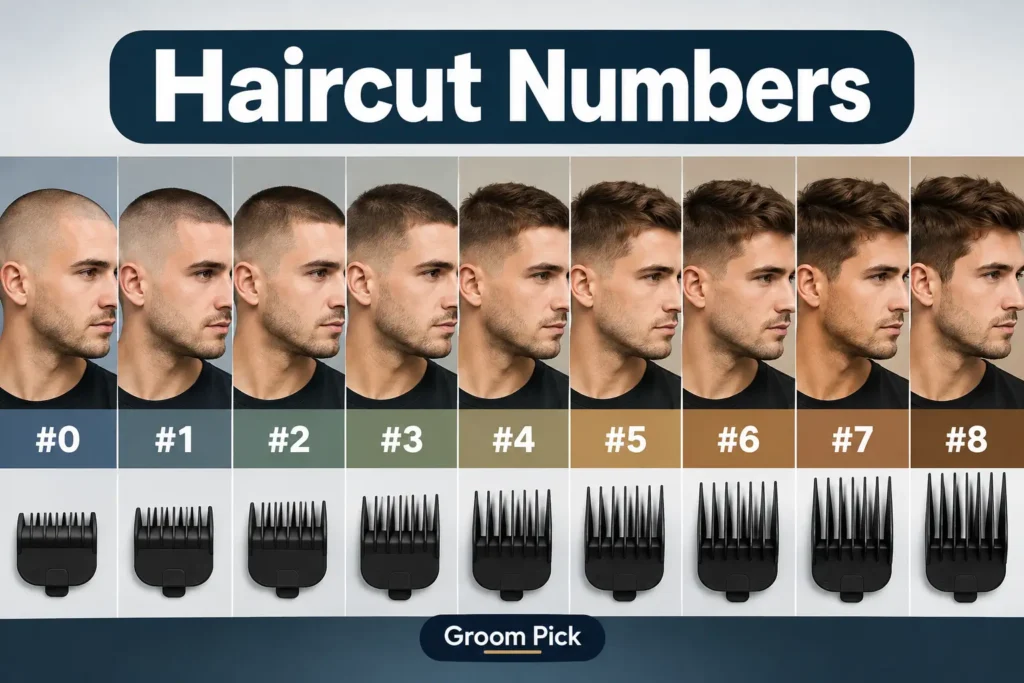
Haircut numbers are clipper guard sizes used by barbers to control hair length. The lower the number, the shorter the hair. The higher the number, the more hair remains.
Most common clipper guards range from #0 or a bare blade up to #8.
Here is the basic system:
| Haircut Number | Approx. Length | General Look |
|---|---|---|
| #0 | 0–1.5 mm | Almost shaved |
| #1 | 3 mm / ⅛ inch | Very short |
| #2 | 6 mm / ¼ inch | Short |
| #3 | 10 mm / ⅜ inch | Short with more coverage |
| #4 | 13 mm / ½ inch | Medium-short |
| #5 | 16 mm / ⅝ inch | Longer |
| #6 | 19 mm / ¾ inch | Long clipper cut |
| #7 | 22 mm / ⅞ inch | Very long clipper cut |
| #8 | 25 mm / 1 inch | About one inch |
Exact measurements can vary slightly between clipper brands and models.
Quick Answer: What Do Haircut Numbers Mean?
Haircut numbers tell your barber how short to cut your hair with electric clippers.
- #0: Almost shaved
- #1: Very short, about 3 mm
- #2: Short, about 6 mm
- #3: About 10 mm
- #4: About 13 mm
- #5: About 16 mm
- #6: About 19 mm
- #7: About 22 mm
- #8: About 25 mm
The easiest rule to remember is:
Lower number = shorter hair. Higher number = longer hair.
Key Takeaways
- A haircut number refers to a clipper guard size.
- A #1 haircut leaves around 3 mm of hair.
- A #2 haircut leaves around 6 mm.
- A #3 haircut leaves around 10 mm.
- A #4 haircut leaves around 13 mm.
- A #0 is extremely close and may expose a lot of scalp.
- Haircut numbers can be combined to create fades and tapers.
- Your hair type can make the same number look different.
- When talking to a barber, explain where you want each number used.
Haircut Number Chart
The following chart gives you a quick way to compare clipper sizes.
#0 Haircut
A #0 is one of the shortest clipper options. Depending on the blade and setting, it can leave almost no visible hair.
It is commonly used at the bottom of very short fades.
A #0 can expose the scalp, so it creates a much more dramatic appearance than a #2 or #3.
Best for: Skin-close looks, very short fades, and people who want almost shaved sides.
#1 Haircut
A #1 haircut leaves approximately 3 mm or ⅛ inch of hair.
It is very short and usually shows some scalp, especially if the hair is thin or light.
A #1 is often used on the sides of short hairstyles or as part of a fade.
Best for: Very short buzz cuts, short fades, and low-maintenance hairstyles.
#2 Haircut
A #2 leaves approximately 6 mm or ¼ inch of hair.
It provides more coverage than a #1 while remaining short and easy to maintain.
For many people, a #2 is a good balance between a very short haircut and a slightly fuller look.
Best for: Short buzz cuts, simple hairstyles, and faded sides.
#3 Haircut
A #3 leaves around 10 mm or ⅜ inch of hair.
This length gives noticeably more coverage than a #1 or #2. It still looks short but does not feel as close to the scalp.
A #3 can also work well as an all-over buzz cut.
Best for: Classic short haircuts, buzz cuts, and people who want more coverage.
#4 Haircut
A #4 leaves approximately 13 mm or ½ inch of hair.
It is a popular choice for people who want short hair without going extremely close.
There is enough length for some texture and styling, although it remains much shorter than most traditional scissor cuts.
Best for: Short textured styles, longer buzz cuts, and people who want a safer option than a #1 or #2.
#5 Haircut
A #5 leaves approximately 16 mm or ⅝ inch.
At this point, the hair has enough length to look fuller while still being easy to maintain with clippers.
Best for: Longer buzz cuts and short hairstyles with more volume.
#6 Haircut
A #6 leaves approximately 19 mm or ¾ inch.
It gives the hair considerably more coverage than the shorter guards.
Best for: Longer clipper cuts and styles where you want a little more length without using scissors.
#7 Haircut
A #7 leaves approximately 22 mm or ⅞ inch.
This is a relatively long clipper setting. Many barbers may use scissors instead when shaping hair at this length, depending on the desired style.
#8 Haircut
A #8 leaves approximately 25 mm or 1 inch.
It is one of the longest commonly available standard clipper guards.
A #8 can be useful when you want to remove some length while keeping plenty of hair.
What Does a Haircut Number Mean in a Fade?
A haircut number does not necessarily describe the entire haircut.
Barbers often use several clipper guards to create a fade.
For example, a barber might use:
- #0 at the very bottom.
- #1 slightly higher.
- #2 above that.
- #3 higher on the sides.
- Scissors or a longer guard on top.
The barber blends each length into the next. This creates the gradual transition that makes a fade look smooth.
Common Fade Combinations
| Fade Combination | General Result |
|---|---|
| #0 → #1 → #2 | Very short, sharp fade |
| #1 → #2 → #3 | Short but slightly softer fade |
| #2 → #3 → #4 | Subtle, fuller fade |
| #0 → #2 → #4 | Strong contrast with more length on top |
The exact numbers used depend on the haircut, hair type, and barber’s technique.
#1 vs. #2 Haircut
The difference between a #1 and #2 may seem small, but it is noticeable.
A #1 leaves about 3 mm, while a #2 leaves about 6 mm.
That means a #2 leaves roughly twice as much hair as a #1.
Choose a #1 if you want:
- A very short look
- More visible scalp
- Minimal maintenance
- Very short faded sides
Choose a #2 if you want:
- More scalp coverage
- A slightly softer appearance
- A short but less extreme haircut
- An easy-to-maintain style
If you’re unsure, the #2 is usually the less dramatic choice.
#2 vs. #3 Haircut
A #2 leaves about 6 mm, while a #3 leaves about 10 mm.
The #3 gives noticeably more coverage and usually looks fuller.
Choose a #2 if you want a sharper, shorter appearance.
Choose a #3 if you want a little more texture and coverage.
For someone trying a short haircut for the first time, a #3 can be a comfortable starting point.
#3 vs. #4 Haircut
A #3 is approximately 10 mm, while a #4 is approximately 13 mm.
Both are short, but a #4 looks fuller.
A #3 works well for a classic buzz cut. A #4 can give you more flexibility if you want to keep some texture.
How to Choose the Right Haircut Number
Choosing the right number depends on your preferred look, hair type, and how much maintenance you want.
Step 1: Decide How Short You Want to Go
If you want extremely short hair, consider #0 or #1.
For a standard short haircut, consider #2 or #3.
For more coverage, consider #4 or higher.
Step 2: Think About Your Scalp
Very short hair makes the scalp more visible.
If you have areas where the scalp is naturally more noticeable, you may prefer a #3 or #4 rather than a #1.
Step 3: Consider Your Hair Type
Straight, wavy, curly, and coily hair can look different at the same clipper length.
Curly hair, for example, may appear shorter because the hair naturally contracts into curls.
Step 4: Decide Whether You Want a Fade
If you want a fade, tell your barber where you want it:
- Low fade
- Mid fade
- High fade
- Taper fade
- Skin fade
Then tell them how much length you want to keep on top.
Step 5: Show a Reference Photo
A photo can be more useful than a number alone.
Two people can say “#2 fade” and have different ideas about the finished style.
What Should You Tell Your Barber?
Instead of simply saying, “Give me a number 2,” give your barber more information.
For example:
“I want a #2 on the sides, a low fade, and keep the top longer.”
Or:
“Give me a #3 all over and clean up the edges.”
Or:
“Start with a #1 around the sides and blend it into a #3. Keep the top longer.”
This makes your request much clearer.
Haircut Numbers for Different Hair Types
Straight Hair
Straight hair usually shows the clipper length clearly. A #1 or #2 can create a very uniform appearance.
Wavy Hair
Wavy hair may look slightly fuller than straight hair at the same clipper length.
Curly Hair
Curly hair can appear shorter than expected because the curls naturally shrink toward the scalp.
Coily Hair
Coily hair can create a strong texture even at short lengths. Your barber may adjust the guard and blending technique based on your curl pattern and density.
Haircut Numbers vs. Scissor Cuts
Clipper numbers are mainly useful for short, even lengths.
Scissors are better when you want:
- Layers
- Longer hair
- More texture
- A specific shape
- More length on top
- Detailed styling
That’s why many popular hairstyles combine both techniques.
For example:
#2 sides + scissors on top
is a common way to create a clean short haircut while keeping styling options on top.
Pros and Cons of Different Haircut Numbers
| Number | Pros | Cons |
|---|---|---|
| #0 | Extremely low maintenance | Very little coverage |
| #1 | Very short and clean | Scalp can be highly visible |
| #2 | Easy to maintain | Limited styling options |
| #3 | Good balance of length and coverage | Still quite short |
| #4 | Fuller appearance | Less of a traditional buzz cut |
| #5–#8 | More length and styling flexibility | Requires more maintenance |
Common Haircut Number Mistakes
Choosing the right haircut number is simple, but small communication mistakes can change the final look. Knowing what to tell your barber can help you avoid an unwanted cut.
Always explain the length, fade, top, and hairline you want instead of giving only a clipper number.
Asking for a Number Without Explaining Where
A “#2 haircut” could mean #2 all over or #2 on the sides.
Always explain where you want the number.
Choosing Too Short
If you are nervous, start with a longer guard.
Hair can always be cut shorter. You cannot immediately add the length back.
Forgetting the Top
Tell your barber whether the top should match the sides or stay longer.
Assuming Numbers Look the Same on Everyone
Hair thickness, texture, color, and scalp visibility affect the final appearance.
Ignoring the Hairline
Very short hair makes your natural hairline more noticeable. If you want a sharp or natural finish, tell your barber.
Haircut Number Checklist
Before your haircut, decide:
- What number do I want on the sides?
- Do I want a fade?
- Do I want a low, mid, or high fade?
- How long should the top be?
- Should the top be cut with scissors?
- Do I want a natural or sharp hairline?
- Do I have a reference photo?
- Am I comfortable with how much scalp will show?
Final Verdict: Choose Your Haircut Number
Haircut numbers make it easier to communicate hair length to your barber. The lower the number, the shorter the hair.
For a quick memory trick:
#0 = almost shaved
#1 = very short
#2 = short
#3 = short with coverage
#4 = medium-short
#5–#8 = longer clipper lengths
If you’re unsure, don’t give your barber only a number. Explain the sides, top, fade, and desired length. A reference photo can also help.
The best haircut number is not simply the shortest one. It is the length that matches your hair type, face shape, preferred style, and how much maintenance you want.
Frequently Asked Questions
What is a #1 haircut?
A #1 haircut uses a #1 clipper guard and usually leaves around 3 mm or ⅛ inch of hair. It is a very short haircut and may show significant scalp.
Is a #2 haircut very short?
Yes. A #2 leaves about 6 mm or ¼ inch of hair. It is short, but it provides more coverage than a #1 and is often used for buzz cuts and fades.
Can I get a #2 haircut with a fade?
Yes. A #2 can be used higher on the sides while shorter guards are used toward the bottom. This creates a gradual fade.
Should I get a #1 or #2 haircut?
Choose a #1 if you want an extremely short style. Choose a #2 if you want more coverage while keeping the haircut short and low maintenance.
Why does the same haircut number look different on different people?
Hair texture, thickness, color, curl pattern, and scalp visibility all affect how a particular clipper length looks.
When should I choose a #4 instead of a #2?
Choose a #4 when you want more coverage and texture. A #2 is much shorter, while a #4 leaves about 13 mm or ½ inch of hair.